
Fibrosis measures in the mouse study
This paper studied a mouse model of MASH. Its abstract distinguishes two fibrosis measures: Sirius Red–based fibrosis area and scores did not differ significantly among treatment groups, while SHG/TPEF imaging showed lower perisinusoidal collagen measures. The authors call for confirmation in longer studies. These findings do not establish an antifibrotic effect in patients.
Original Diabetes, Obesity and Metabolism paper, 20 January 2026 ↗
Original report · translated from Chinese
A collaborative study by Innogen and Huashan Hospital, Fudan University, on efsubaglutide alfa was recently published in Diabetes, Obesity and Metabolism. Focusing on metabolic dysfunction-associated steatohepatitis (MASH), the study systematically assessed effects on hepatic steatosis, liver injury and fibrosis-related changes in a nonclinical mouse model induced by a high-fat diet combined with carbon tetrachloride.
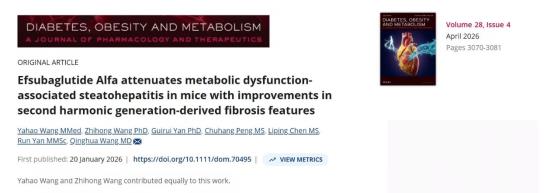 Image text and data — Diabetes, Obesity and Metabolism publication detailsThe original-research title is ‘Efsubaglutide Alfa attenuates metabolic dysfunction-associated steatohepatitis in mice with improvements in second harmonic generation-derived fibrosis features.’ The authors shown are Yahao Wang, Zhihong Wang, Guirui Yan, Chuhang Peng, Liping Chen, Run Yan and Qinghua Wang. The note states that Yahao Wang and Zhihong Wang contributed equally. First publication is dated 20 January 2026, DOI 10.1111/dom.70495. The issue panel identifies Diabetes, Obesity and Metabolism, volume 28, issue 4, April 2026, pages 3070–3081. |
Efsubaglutide alfa significantly reduced body weight, liver weight and the liver-to-body-weight ratio in the model animals, improved hepatic lipid deposition, lowered the NAFLD activity score (NAS), and significantly reduced the liver enzymes ALT and AST, fasting glucose and certain blood-lipid measures. Using second-harmonic generation/two-photon excitation fluorescence (SHG/TPEF) imaging with AI analysis, the researchers also observed improvements in fibrosis-related features, including perisinusoidal collagen deposition. These findings suggest potential effects on MASH-related liver pathology in addition to metabolic improvements.
MASH is an important area of metabolic disease research with substantial unmet clinical needs. The study provides preclinical evidence for further research into efsubaglutide alfa’s mechanisms and possible clinical applications of GLP-1 therapies in MASH and related metabolic liver diseases.