
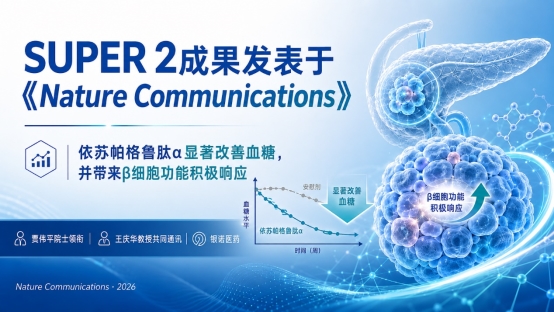
Image text and data — SUPER 2 publication poster
The poster announces publication of SUPER 2 in Nature Communications in 2026, with significant glycaemic improvement and positive beta-cell functional responses with efsubaglutide alfa. It identifies Academician Weiping Jia as study lead, Professor Qinghua Wang as co-corresponding author, and Innogen.
The illustrative graph plots blood-glucose level against time in weeks, with blue for efsubaglutide alfa and grey for placebo, to depict glucose lowering. No numeric scale is supplied, so the poster provides no additional quantitative efficacy values.
Results from the SUPER 2 study of efsubaglutide alfa were recently published in Nature Communications.
Led by Academician Weiping Jia, with Professor Qinghua Wang as a co-corresponding author, the study evaluated efficacy, safety and β-cell functional responses in patients with type 2 diabetes inadequately controlled on metformin. Professor Wang's affiliations in the paper include Huashan Hospital, Fudan University, and Shanghai Innogen. Innogen develops innovative therapies for diabetes and other metabolic diseases, with efsubaglutide alfa among its core products. [1]
SUPER 2 was a randomized, double-blind, placebo-controlled, two-stage adaptive Phase IIb/III trial.
In Phase IIb, participants received 1 mg, 3 mg or placebo for 12 weeks. An independent committee selected 3 mg for Phase III based on efficacy and safety. Phase III then compared efsubaglutide alfa 3 mg with placebo during 24 weeks of double-blind treatment. At week 12 in Phase IIb, HbA1c fell by 1.10 and 1.43 percentage points in the 1 mg and 3 mg groups, respectively. At week 24 in Phase III, the 3 mg group had a 1.80-percentage-point reduction. Adverse events were predominantly mild-to-moderate gastrointestinal reactions.
Beyond confirming glucose-lowering efficacy, SUPER 2 strengthened the mechanistic evidence concerning efsubaglutide alfa's effects on β-cell function.
The study included the mixed-meal tolerance test (MMTT) as a key assessment, tracking post-meal glucose, insulin and C-peptide dynamics alongside HOMA-β, HOMA-IR and disposition index (DI). HOMA-β increased significantly after treatment, suggesting improved β-cell function; the insulin-to-glucagon ratio rose significantly; and the DI curve shifted significantly to the right, suggesting improved overall glucose disposal. Glucose, insulin and C-peptide AUC0–2h during MMTT were also important endpoints, allowing a more direct assessment of β-cell secretory responses.
These results are relevant to our previously published diabetes-remission study.
That study, published in Advances in Therapy, found that some drug-naïve patients with type 2 diabetes achieved remission after completing 52 weeks of efsubaglutide alfa and subsequently stopping treatment. Improvement in HOMA-β after treatment was associated with a higher probability of remission, suggesting that recovery of β-cell function may be an important basis for sustained remission. SUPER 2 provides further mechanistic support in a larger randomized controlled study of participants receiving background metformin. Together, the findings strengthen the scientific rationale that efsubaglutide alfa may improve the underlying pathophysiology of diabetes as well as lowering glucose. [2]
Professor Qinghua Wang is a distinguished professor at Fudan University, the founder of Innogen and the inventor of efsubaglutide alfa.
Publication of SUPER 2 in Nature Communications marks further progress in the evidence for efsubaglutide alfa in type 2 diabetes and highlights the value of linking basic science, mechanistic research and clinical translation. For the GLP-1 class, these findings support a shift from glucose control alone toward greater attention to β-cell protection, intervention in disease progression and long-term benefit. [1]
[1] Jia W, Gao F, Lu J, et al. Efsubaglutide alfa added to metformin improves glycaemia with β-cell functional responses in type 2 diabetes: a randomised, double-blind, placebo-controlled, two-stage adaptive phase 2b/3 trial (SUPER 2). Nature Communications. 2026;17:6222. https://doi.org/10.1038/s41467-026-72574-7
[2] Sun R, Wang K, Yuan G, et al. Diabetes Remission in Drug-Naïve Patients with Type 2 Diabetes After Efsubaglutide Alfa Treatment. Advances in Therapy. 2026;43:1098–1108. https://doi.org/10.1007/s12325-025-03467-2
β-cell functional findings in the original English article
The original English article also reports that efsubaglutide alfa treatment was associated with improved postprandial insulin and C-peptide responses, improved β-cell function-related parameters, and favorable changes in indices integrating insulin secretion and insulin sensitivity. The company interprets these findings as a signal of potential partial improvement in the underlying pathophysiology of type 2 diabetes beyond glycemic control.