
Original report · translated from Chinese
China’s ‘ultra-long-acting’ voice in Hunan
On 18 July 2026, the Hunan Medical Association held its 30th Endocrinology Academic Conference and 18th Diabetes Academic Conference in Yueyang, Hunan. Professors Zhiguang Zhou of the Second Xiangya Hospital and Minxiang Lei of Xiangya Hospital, Central South University, chaired the opening ceremony. Professor Zhou then presented on disease-modifying treatment for type 1 diabetes. Experts including Bo Feng of Shanghai East Hospital, Tongji University; Huijuan Zhu of Peking Union Medical College Hospital; Wei Gu of the Second Affiliated Hospital, Zhejiang University School of Medicine; Minxiang Lei; and Xia Li of the Second Xiangya Hospital discussed clinical care and research in diabetes and related metabolic diseases. In the special lecture session, Professor Qinghua Wang of Huashan Hospital, Fudan University, and founder, Chairman and CEO of Innogen, spoke on ‘China’s Ultra-Long-Acting Voice: Breakthrough Advances in GLP-1RAs for Type 2 Diabetes’. He reviewed GLP-1 receptor agonist discoveries, the evolution of long-acting technologies and the clinical translation of original Chinese medicines.
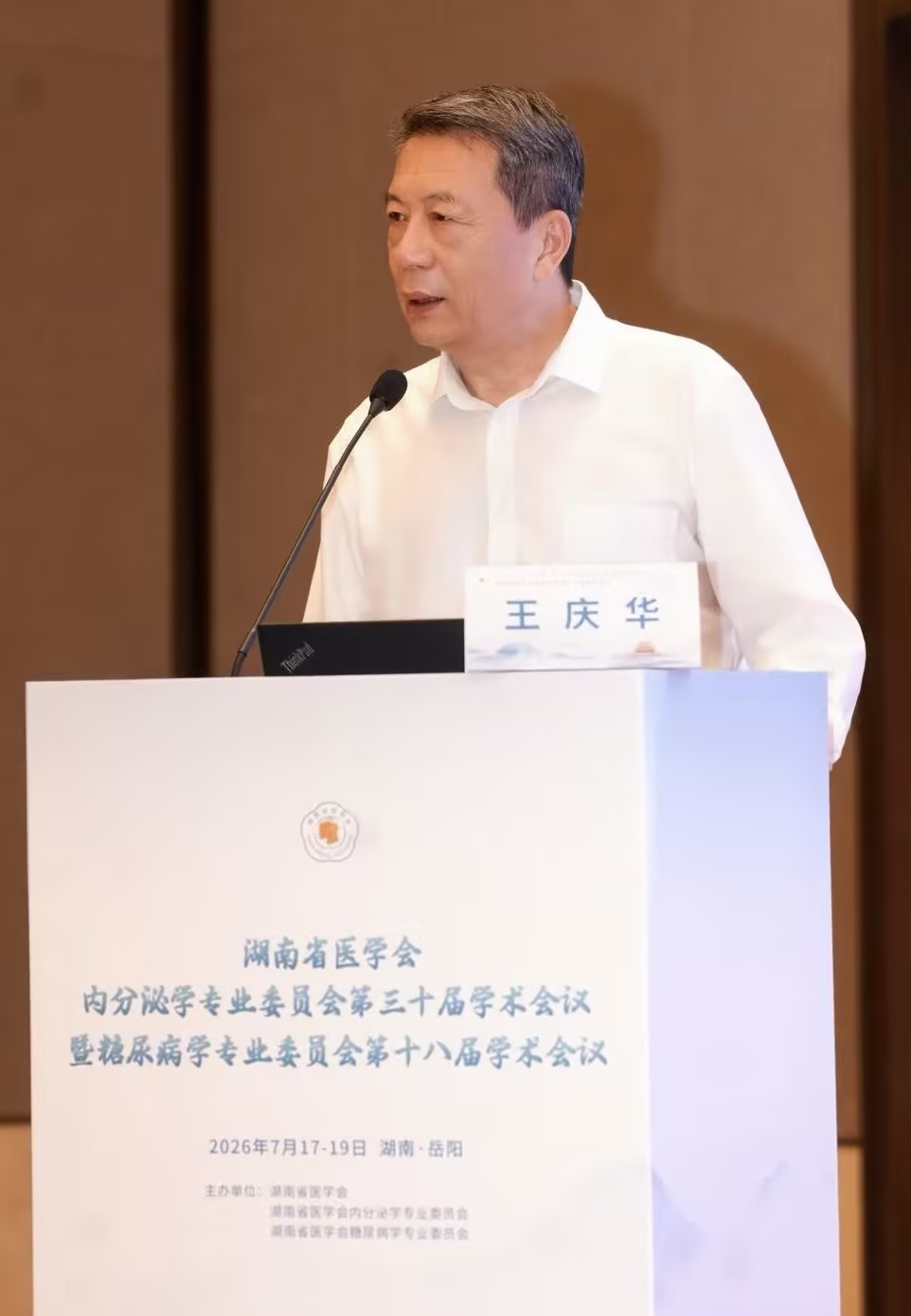
Image text and data — Hunan academic meeting
The lectern identifies the 30th academic meeting of the Hunan Medical Association’s Endocrinology Committee and the 18th academic meeting of its Diabetes Committee, held in Yueyang, Hunan, on 17–19 July 2026. Professor Qinghua Wang is pictured speaking.
From a question about mechanism to a global therapeutic field
Over more than four decades, GLP-1 research has developed from basic physiology into a major drug class reshaping treatment for diabetes, obesity and other metabolic diseases. Professor Wang traced the history from hormone discovery and understanding its mechanism to the first GLP-1 receptor agonist approval in 2005, followed by weekly formulations and a growing range of multi-target medicines.
This history intersects with Professor Wang’s long-standing GLP-1 research. In 2002, he and Professor Brubaker reported biological mechanisms through which GLP-1 improves type 2 diabetes, including increased glucose-dependent insulin secretion and pancreatic β-cell proliferation. In 2005, his team first reported a recombinant fusion-protein strategy for extending GLP-1 activity in the body. Building on basic mechanisms, successive work on half-life, stability, humanisation, pharmacokinetics, manufacturability and clinical benefit formed a continuous path from discovery to drug innovation.
Creating an original medicine: more than extending half-life
Professor Wang explained that ‘ultra-long-acting’ drug development requires a balance among molecular activity, sustained exposure, efficacy, safety, dosing convenience and manufacturing scale. Efsubaglutide alfa fuses a human GLP-1 analogue with an IgG2 Fc fragment. FcRn-mediated recycling delays clearance, while continued optimisation of molecular structure and manufacturing processes supports stable, sustained exposure. Its mean half-life in people with type 2 diabetes is approximately 204 hours, supporting weekly administration and providing a pharmacokinetic basis for clinical investigation of dosing every two weeks.
From early molecular construction through chemistry, manufacturing and controls (CMC) development, nonclinical research, successive clinical stages and registration, efsubaglutide alfa (trade name: Diabegone) reflects more than two decades of continuing work. The NMPA approved it for adult type 2 diabetes in 2025. The approval illustrates the translation of original science through engineering and clinical needs into a Chinese-developed medicine.
Understanding clinical value through the ‘4L’ framework
The presentation used four ‘L’s to describe GLP-1’s clinical value: L-cell, focusing on glucose-dependent insulin secretion and pancreatic β-cell function; Life, encompassing glucose, body weight and multiple cardiometabolic risk factors; Long, addressing the experience of chronic treatment through more sustained and stable exposure; and Liberation, referring to research into disease remission and a reduced long-term treatment burden.
In type 2 diabetes, SUPER 1 found an average reduction in HbA1c of approximately 2.2 percentage points from baseline after 24 weeks of efsubaglutide alfa 3 mg monotherapy. SUPER 2, conducted on a background of metformin, found an average reduction of approximately 1.8 percentage points in the 3 mg group at 24 weeks, together with clinical measures consistent with improved β-cell function. Common adverse reactions in both studies were mainly mild-to-moderate gastrointestinal events, usually occurring early in treatment; overall tolerability was good.
Population used in the remission analysis
The observational follow-up enrolled 29 SUPER 1 participants who had completed 52 weeks of treatment with HbA1c ≤7.0%. In the three-month analysis after treatment withdrawal, 12 of 20 met remission criteria (60%): HbA1c <6.5% measured at least three months after the last dose. The denominator is 20, not all 29 enrollees, and the result does not represent all people with type 2 diabetes.
Building on the prolonged half-life, the researchers conducted a randomised clinical investigation of dosing every two weeks. In SUPER Q2W, 3 mg every two weeks and 1 mg weekly produced similar HbA1c and continuous glucose-monitoring results over 12 weeks, providing further evidence to investigate fewer injections and greater long-term convenience. In another exploratory extension study of newly diagnosed type 2 diabetes, 60% of participants met the American Diabetes Association’s criteria for diabetes remission three months after completing treatment and stopping glucose-lowering medicines. This suggests a direction for further investigation of early intensive treatment and intervention in disease progression.
From glucose lowering to broader metabolic disease research
The presentation also reviewed clinical work in overweight and obesity. In the published Phase IIa LIGHT 1 study, participants receiving efsubaglutide alfa had an average weight reduction of approximately 7.2% from baseline after four weeks at target dose; 84.6% achieved weight loss of at least 5%. Treatment-related adverse events were mainly mild-to-moderate, transient gastrointestinal reactions. No serious adverse events, hypoglycaemic events or early discontinuations due to adverse events occurred in the study.
Phase IIb ENLIGHT topline results showed average weight loss of 10.6% after 18 weeks with 20 mg weekly in participants with overweight or obesity, a waist-circumference reduction of approximately 8.9 cm, and weight loss of at least 5% in 82% of participants. The 20 mg every-two-weeks group had average weight loss of 9.7%. The study also observed signals of improvement in body-composition measures, including fat mass, liver fat and the muscle-to-fat mass ratio. These findings suggest potential for further research in broader metabolic health and require assessment alongside complete published data and subsequent clinical studies.
Bringing original Chinese innovation to patients internationally
From GLP-1 mechanism research through ultra-long-acting fusion-protein design, clinical studies and marketing approval, Professor Wang described a sustained path spanning basic research, drug development and clinical translation. He emphasised that creating something original in life sciences depends on persistent scientific questioning, long-term attention to clinical needs, and the resilience built through repeated validation and optimisation, beyond an individual experiment or endpoint.
Innogen will continue to focus on diabetes, obesity and related metabolic diseases. Drawing on original biological discoveries and its recombinant-protein platform, it intends to advance efsubaglutide alfa and subsequent innovative programs through clinical and international development, aiming to translate more Chinese discoveries into accessible, reliable treatment options.
Note: Efsubaglutide alfa’s currently approved indication is type 2 diabetes. Obesity and weight-loss indications remain under clinical investigation and have not received marketing approval. This content communicates company research developments and industry information; it is not a pharmaceutical advertisement, treatment recommendation or promise of efficacy. Prescription medicines should be purchased with a physician’s prescription and used under medical supervision.
About Innogen
Founded in 2014, Innogen (HK.2591) is a biopharmaceutical company focused on developing and commercialising innovative medicines for metabolic diseases. Its internally developed pipeline covers indications including type 1 diabetes (T1D), obesity, metabolic dysfunction-associated steatohepatitis (MASH) and Alzheimer’s disease (AD), with international intellectual-property rights and a global patent strategy. Its core product, efsubaglutide alfa, is an internally developed, next-generation human-derived ultra-long-acting GLP-1 receptor agonist approved for type 2 diabetes in the Chinese mainland and Macao, China. It is included in the National Basic Medical Insurance, Maternity Insurance and Work Injury Insurance Drug List (2025). The product has entered international development and registration, with the aim of providing better treatment options to patients worldwide. For more information, visit:
www.innogenpharm.com.