
The inaugural China Pharmaceutical Innovation Conference (CPIC 2026) was recently held in Shanghai. In the session on advances in peptide drug development, Professor Qinghua Wang, founder, Chairman and CEO of Innogen, delivered a presentation entitled ‘The GLP-1 Research and Development Journey and Outlook’.
Beginning with the global pharmaceutical innovation landscape, the presentation traced GLP-1 from basic biological discovery and understanding of its mechanism through long-acting molecular design, clinical development and commercial use. Innogen’s internally developed efsubaglutide alfa illustrated the full development journey of an original Chinese biologic, from scientific discovery to industrial production.
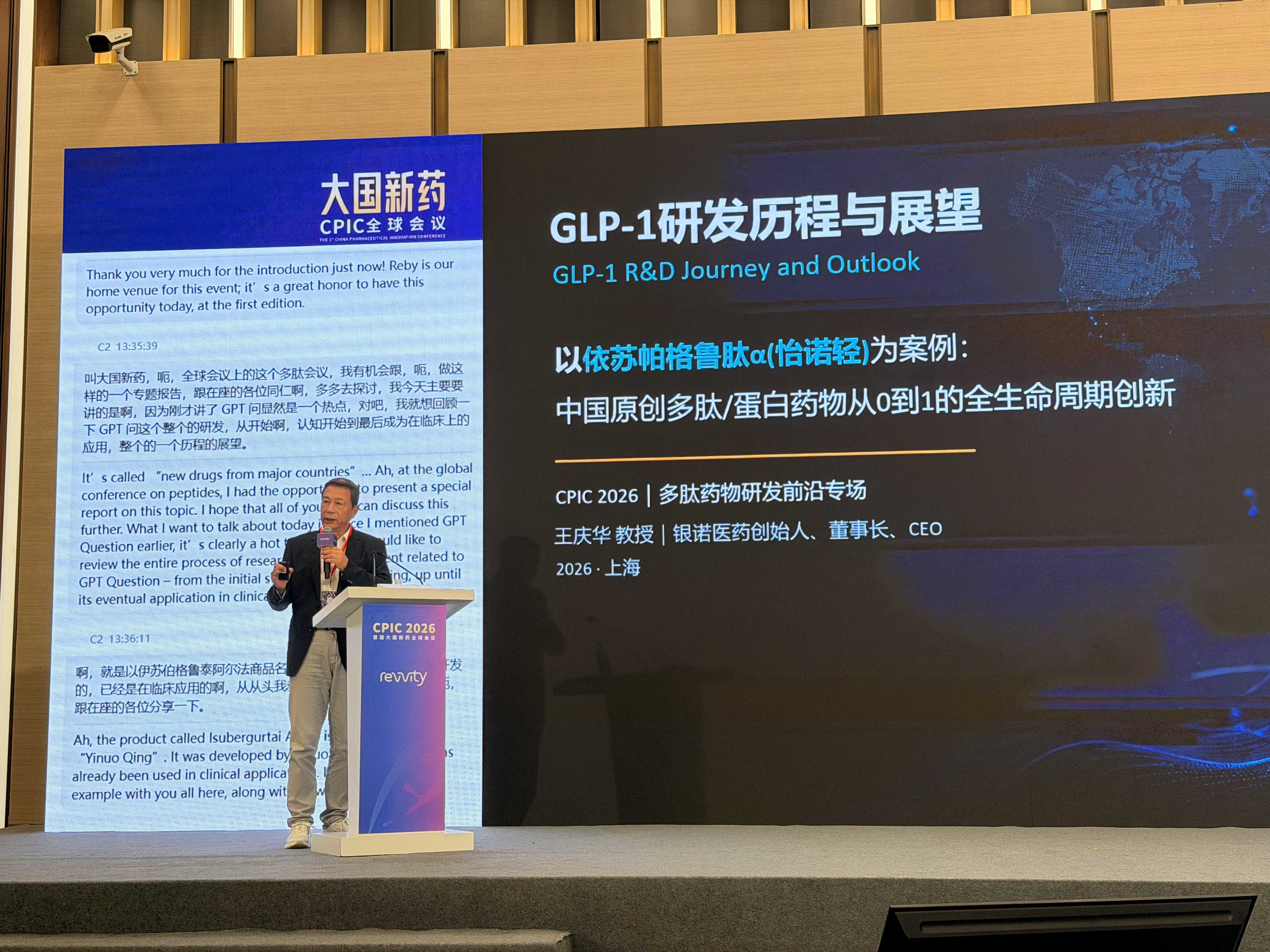
Image text and data — Presentation at CPIC 2026
The presentation is titled GLP-1 R&D Journey and Outlook. It uses efsubaglutide alfa (Diabegone) as a case study in the full development lifecycle of an original peptide or protein medicine from China. The slide identifies the CPIC 2026 session on frontiers in peptide-drug R&D, held in Shanghai, with Professor Qinghua Wang speaking.
China’s innovative medicines are advancing; the capacity to create something original matters more than ever
Out-licensing transactions involving Chinese innovative medicines continued to grow rapidly in 2025, reflecting increasing international recognition of China’s drug-development efficiency, clinical capabilities and the quality of its innovative assets.
Professor Wang said that growing out-licensing activity is an important sign of this progress. However, the next stage of development requires attention beyond transaction numbers and potential deal values. It requires asking whether a medicine rests on original scientific discovery and whether its developers have completed the entire process: target discovery and validation, molecular design, chemistry, manufacturing and controls (CMC), quality characterisation, nonclinical research, clinical validation, registration, manufacturing and commercialisation.
Meaningful innovation requires sustained investment and integration across original science, drug engineering, clinical development, quality systems and commercial capabilities, extending beyond a breakthrough at any individual stage.
The development of efsubaglutide alfa exemplifies this approach to innovation across a medicine’s lifecycle, from an original idea and laboratory work to patients.
From insulin to GLP-1: evolving approaches to diabetes treatment
The presentation first reviewed the history of diabetes treatment.
The discovery of insulin transformed diabetes from a fatal illness into a treatable chronic disease, marking a major advance in modern medical history. As understanding of the gut–pancreas axis and the incretin effect developed, GLP-1 emerged as an important gut-derived metabolic hormone and eventually became a major drug target in metabolic disease.
Early research focused on GLP-1’s glucose-dependent stimulation of insulin secretion. Its biological significance, however, extends further.
In 2002, Professor Wang’s team first reported molecular and cellular mechanisms underlying GLP-1 treatment of type 2 diabetes. Their work showed effects beyond insulin secretion, including improved pancreatic β-cell function, promotion of insulin synthesis and processing, and positive effects on β-cell survival and maintenance of function.
This understanding of effects beyond stimulating insulin secretion broadened GLP-1 research from stimulation of insulin secretion to β-cell protection, glucagon regulation, gastric emptying, appetite control, weight management and metabolic benefits across multiple organs.
GLP-1 consequently developed from a glucose-lowering target into a therapeutic platform encompassing diabetes, obesity and related metabolic diseases.
From scientific hypothesis to an original molecule: the GLP-1/Fc fusion strategy
Native GLP-1 has a very short half-life in the body and is rapidly degraded by enzymes and cleared by the kidneys. Extending its duration of action while preserving biological activity was a central challenge in early GLP-1 drug development.
Drawing on long-term research into GLP-1 biology, Professor Wang’s team proposed recombinant fusion proteins as a route to longer action. In 2005, the team reported the long-acting glucose-lowering mechanism of a GLP-1/Fc fusion protein, laying the groundwork for subsequent efsubaglutide alfa molecular design and patent development.
Efsubaglutide alfa combines a human GLP-1 analogue with a selected IgG2 Fc fragment. Its design addresses several goals: retaining GLP-1 receptor agonist activity, reducing enzymatic degradation and renal filtration, extending circulation through FcRn-mediated recycling, and reducing potential immunogenicity through a humanised molecular design.
Clinical pharmacokinetic studies found a mean half-life of approximately 204 hours in patients with type 2 diabetes, providing a pharmacological basis for weekly dosing and further investigation of dosing every two weeks.
An original molecule must be manufacturable—and consistently manufactured to a high standard
The presentation emphasised that biological activity is only the starting point for peptide and recombinant-protein medicines.
For a candidate to reach clinical trials and eventually commercial use, developers must resolve CMC challenges including stable cell-line construction, fermentation and purification processes, impurity control, structural and functional characterisation, formulation stability, manufacturing scale-up and batch consistency.
The quality of an innovative medicine therefore depends on both clinical efficacy and stable, scalable, verifiable manufacturing and quality-control systems that meet international regulatory standards.
Efsubaglutide alfa has progressed through molecular construction, process development, nonclinical research, manufacture of clinical supplies, commercial-scale production and continuing quality management. This journey illustrates the integrated engineering capabilities required to turn an original Chinese biologic from a laboratory result into an industrial product.
Adaptive clinical design supports efficient development; the SUPER studies assess clinical value
Efsubaglutide alfa’s clinical development used an innovative two-stage adaptive Phase IIb/III design.
Several candidate doses were assessed in Phase IIb. A suitable dose was then selected for seamless progression into Phase III using predefined criteria and an independent data monitoring committee’s overall assessment. This approach improved dose selection and later-stage development efficiency while maintaining scientific rigour.
In patients with type 2 diabetes who had not previously received glucose-lowering medicines, SUPER 1 showed a significant reduction in HbA1c with efsubaglutide alfa monotherapy. With 3 mg once weekly for 24 weeks, HbA1c fell by approximately 2.2 percentage points from baseline, with improvements also observed in fasting glucose, blood lipids and selected cardiometabolic risk measures.
In patients whose glucose remained inadequately controlled on metformin, SUPER 2 showed an approximately 1.8-percentage-point reduction in HbA1c from baseline after 24 weeks of efsubaglutide alfa 3 mg once weekly. Physiological signals associated with improved pancreatic β-cell function were also observed.
SUPER 1 and SUPER 2 supported efsubaglutide alfa’s glucose-lowering efficacy and overall safety and tolerability, while illustrating continuity between early mechanism research and clinical functional assessment.
A longer half-life should translate into value for patients
Dosing frequency, continuity of treatment and adherence matter in chronic metabolic diseases requiring long-term therapy.
Efsubaglutide alfa’s prolonged and relatively stable exposure creates the possibility of fewer injections. Randomised clinical research in newly diagnosed type 2 diabetes found good HbA1c and continuous glucose-monitoring control with both 3 mg every two weeks and 1 mg weekly.
Dosing every two weeks would mean approximately 26 fewer injections per year. Besides convenience, it could potentially reduce the burden of long-term treatment, improve adherence and broaden the clinical settings in which an ultra-long-acting GLP-1 receptor agonist could be used.
From this perspective, a pharmacokinetic advantage becomes meaningful differentiation only when it translates into efficacy, safety, convenience and sustained treatment over time.
From diabetes to weight management: expanding metabolic disease research
The clinical value of GLP-1 medicines has gradually extended from glucose control into weight management and metabolic improvements involving multiple organs.
Clinical studies of efsubaglutide alfa in overweight and obesity have shown reductions in body weight and waist circumference, with improvements in measures including fat mass, muscle-to-fat ratio and liver fat.
In the Phase IIa LIGHT 1 study, participants receiving target-dose treatment had an average weight reduction of approximately 7.2%, an average fat-mass reduction of approximately 4.5 kg and an improved muscle-to-fat ratio. Treatment-related adverse events were mainly mild-to-moderate gastrointestinal reactions.
The subsequent Phase IIb ENLIGHT study assessed 5 mg, 10 mg and 20 mg once weekly and 20 mg every two weeks. These regimens provided dose–exposure, efficacy and safety evidence to inform further development in weight management.
These studies suggest potential extending beyond a single glucose measure. Improvements across glucose, body weight, fat distribution and other metabolic measures could potentially provide additional treatment options for people with different metabolic diseases.
From marketing approval to clinical access: delivering the value of innovation
In 2025, the National Medical Products Administration approved efsubaglutide alfa for adult type 2 diabetes. The approval marked its progression from original mechanism research and molecular design through pharmaceutical and nonclinical development, clinical validation and registration.
Efsubaglutide alfa entered the National Reimbursement Drug List in 2026, further improving clinical access.
For an innovative medicine, approval is one stage in a longer journey. Innovation delivers its value when scientific discovery becomes a consistently manufactured product and reaches patients through registration, market access and clinical use.
Further work on efsubaglutide alfa continues in weight management, longer dosing intervals, and international clinical development and registration, extending exploration of its lifecycle potential.
The future of GLP-1: broader innovation beyond individual efficacy measures
GLP-1 will remain an important frontier in metabolic drug innovation.
Single-target GLP-1 medicines offer further opportunities through molecular engineering, longer action, optimisation of tissue distribution, delivery systems and tolerability. GLP-1/GIP, GLP-1/glucagon and other dual- and multi-target medicines will also continue to expand therapeutic possibilities.
Future competition should extend beyond the amount of weight lost or any single short-term efficacy measure.
A metabolic medicine with lasting clinical value needs to balance efficacy, safety, the quality of weight management, dosing convenience, manufacturability, long-term adherence, access and international development capability.
Professor Wang said that Chinese pharmaceutical innovation is entering a new stage in which original quality becomes a stronger driver alongside development efficiency. Efsubaglutide alfa’s development shows that Chinese teams can both work on internationally important targets and start from original scientific questions to carry a medicine through mechanism discovery, molecular creation, industrial production and commercialisation.
For Chinese innovation to deliver value internationally, the decisive issue is whether China can consistently produce medicines founded on original science, a complete development chain and global clinical value, beyond the number of projects licensed out.
Efsubaglutide alfa’s journey from an original concept to a medicine represents one such effort to advance the quality of Chinese drug innovation.
Note: Efsubaglutide alfa’s currently approved indication is type 2 diabetes. Obesity and weight-loss indications remain under clinical investigation and have not received marketing approval. This content communicates company research developments and industry information; it is not a pharmaceutical advertisement, treatment recommendation or promise of efficacy. Prescription medicines should be purchased with a physician’s prescription and used under medical supervision.
About Innogen
Founded in 2014, Innogen (HK.2591) is a biopharmaceutical company focused on developing and commercialising innovative medicines for metabolic diseases. Its internally developed pipeline covers indications including type 1 diabetes (T1D), obesity, metabolic dysfunction-associated steatohepatitis (MASH) and Alzheimer’s disease (AD), with international intellectual-property rights and a global patent strategy. Its core product, efsubaglutide alfa, is an internally developed, next-generation human-derived ultra-long-acting GLP-1 receptor agonist approved for type 2 diabetes in the Chinese mainland and Macao, China. It is included in the National Basic Medical Insurance, Maternity Insurance and Work Injury Insurance Drug List (2025). The product has entered international development and registration, with the aim of providing better treatment options to patients worldwide. For more information, visit www.innogenpharm.com.