
Study scope and further validation
The company’s original English version further emphasizes that this hydrogel research remains at the rodent stage and that projections of monthly dosing in humans require larger-animal studies and clinical validation. The original paper confirms that only rats and mice were studied. Extrapolating three-week effects in mice to monthly human dosing relies on metabolic-scaling assumptions and requires further pharmacokinetic and clinical validation.
The company’s English version also identifies long-acting formulations and combination strategies as directions for future work. These are research plans, not approved dosing regimens.
Original report · translated from Chinese
Innogen and Fudan University Publish Collaborative Research on an Ultra-Long-Acting GLP-1 Receptor Agonist in Theranostics
A collaborative study by Innogen and Fudan University's Department of Macromolecular Science on ultra-long-acting delivery of a GLP-1 receptor agonist (GLP-1RA) was recently published online in Theranostics. Entitled ‘Long-acting management of diabetes and associated complications using an injectable thermosensitive hydrogel incorporating IgG-conjugated GLP-1RA’, the study developed a sustained-release formulation of efsubaglutide alfa (Suba) using an injectable thermosensitive hydrogel platform, offering a new technical approach to long-term diabetes management.
Diabetes is a chronic disease that poses a serious threat to public health. In recent years, GLP-1 receptor agonists have shown benefits in glycaemic control, weight management and cardiovascular risk reduction, becoming an important injectable treatment for type 2 diabetes. Even with once-weekly formulations, however, patients still need repeated injections over the long term. Reducing injection frequency and treatment burden is therefore an important objective in clinical practice and drug development.
Independently developed by Innogen, efsubaglutide alfa (Suba) is a long-acting IgG2-Fc fusion GLP-1 receptor agonist with a high molecular weight, high stability and a long half-life. It has been approved in China and included in national reimbursement for once-weekly treatment of adults with type 2 diabetes. This collaboration incorporated Suba into an injectable thermosensitive hydrogel made from the triblock copolymer PLGA-PEG-PLGA (Suba@T-gel). At room temperature, the formulation is a low-viscosity solution suitable for subcutaneous injection. At body temperature, it rapidly forms a gel in situ, creating a stable drug depot for more sustained and even release.
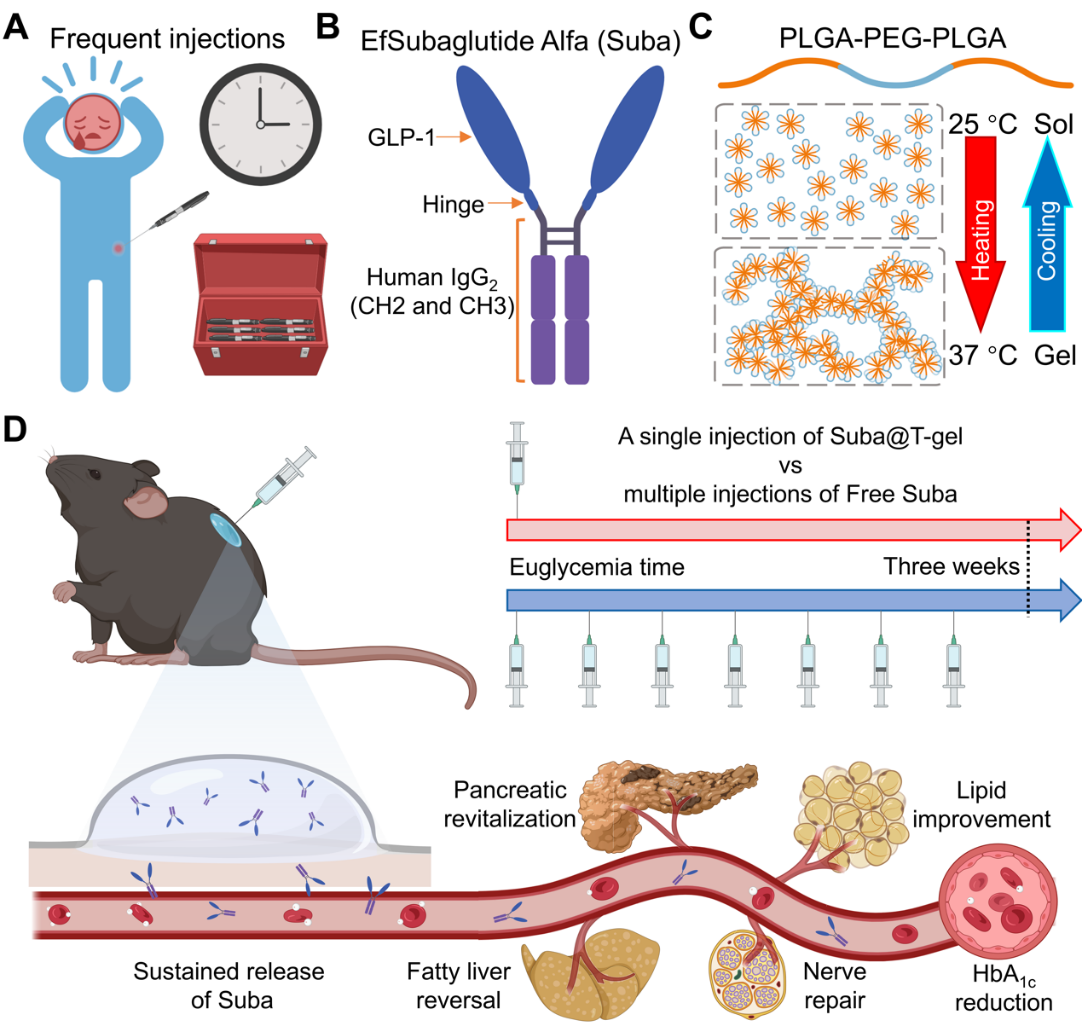
Image text and data — Theranostics schematic: thermosensitive hydrogel delivery of efsubaglutide alfa
Panel A illustrates the burden of frequent injections. Panel B shows efsubaglutide alfa (Suba): GLP-1 is joined by a hinge to the CH2 and CH3 regions of human IgG2.
Panel C shows PLGA-PEG-PLGA as a sol at 25°C and a gel at 37°C, with reversible heating and cooling. Panel D depicts a subcutaneous depot releasing Suba continuously in a mouse. A single Suba@T-gel injection is compared with multiple injections of free Suba, with three weeks marked as the period of euglycaemia.
The organ labels describe pancreatic revitalisation, lipid improvement, fatty-liver reversal, nerve repair and HbA1c reduction. This is a schematic of mechanisms and findings in diabetic mice.
In several mouse models of diabetes, Suba@T-gel showed glycaemic control and benefits across multiple systems. A single subcutaneous injection maintained stable glucose-lowering activity for approximately three weeks in db/db mice and streptozotocin-induced models, significantly improving fasting and postprandial glucose and lowering glycated haemoglobin. It also promoted pancreatic beta-cell proliferation, reduced apoptosis, and improved islet structure and function. The formulation slowed weight gain and fat accumulation, improved dyslipidaemia, reduced hepatic steatosis, improved liver-function measures, and showed some protection of structures and functions affected by diabetic peripheral neuropathy. These results suggest potential for addressing both hyperglycaemia and complications.
One injection of Suba@T-gel maintained glucose control for approximately three weeks in mice. Considering the faster metabolism of mice relative to humans, together with previous cross-species pharmacokinetic data, the authors suggest that a similar sustained-release strategy could eventually allow exploration of once-monthly or even longer dosing intervals in humans, beyond existing weekly formulations. This is a promising technical route towards less frequent GLP-1 treatment, but whether it can be achieved in patients must be established through future clinical trials.
Professor Lin Yu of Fudan University's Department of Macromolecular Science and Professor Qinghua Wang of Innogen were joint corresponding authors; Fudan doctoral researcher Hancheng Wang was first author. The work is another result of Innogen's research into long-acting delivery systems and metabolic diseases, and an example of university–industry collaboration intended to accelerate translation of original research. Innogen plans to continue working with partners on GLP-1 and related programmes, with the aim of delivering fewer injections, more sustained glucose control and fewer chronic complications for people with diabetes.
Reference: Wang H, Chen Z, Gu S, Wang Y, Wang Y, Gao C, Shi J, Ding J, Wang Q, Yu L. Long-acting management of diabetes and associated complications using an injectable thermosensitive hydrogel incorporating IgG-conjugated GLP-1RA. Theranostics 2026; 16(4):1833-1854. doi:10.7150/thno.120844.
Original article: https://www.thno.org/v16p1833.htm