
Original report
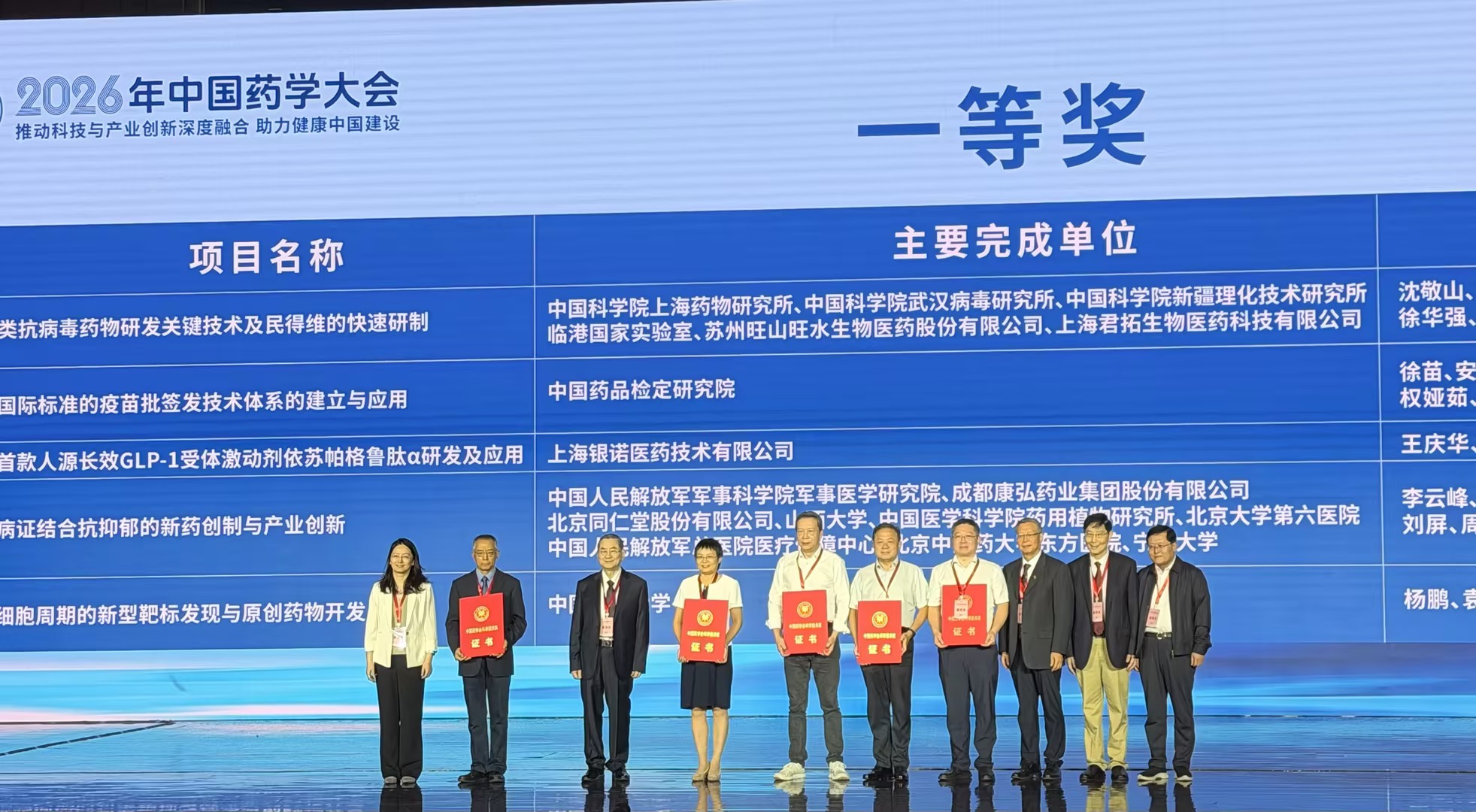
The results of the 21st Chinese Pharmaceutical Association Science and Technology Award were recently announced. Innogen Pharmaceuticals (HK.2591) received the First Prize for its independently developed National Class 1 innovative drug, Efsubaglutide Alfa, for the project entitled “Development and Application of Efsubaglutide Alfa, Asia’s First Human-Based Long-Acting GLP-1 Receptor Agonist.”
Only two projects from pharmaceutical companies were recognized in this year’s awards, with Innogen being the only company to receive the First Prize, underscoring its strength in original innovation and its growing leadership in the field of metabolic diseases.
The Chinese Pharmaceutical Association Science and Technology Award is one of the major scientific and technological awards in China’s pharmaceutical sector. It aims to promote pharmaceutical innovation and the translation of scientific achievements into clinical and commercial applications. This year’s awards were selected following recommendations from professional committees and provincial pharmaceutical associations, followed by a rigorous expert review organized by the Chinese Pharmaceutical Association. A total of 16 projects were ultimately selected.
More Than Two Decades of R&D: Developing a Human-Based Long-Acting GLP-1 Receptor Agonist
Efsubaglutide Alfa is a National Class 1 innovative drug independently developed by Innogen and the first human-based long-acting GLP-1 receptor agonist approved in Asia. The program was also selected for China’s 13th Five-Year Plan National Major New Drug Innovation and Development Program. It is currently approved in mainland China and Macao for the treatment of adults with type 2 diabetes and has been included in China’s National Reimbursement Drug List.
Efsubaglutide Alfa is engineered by fusing a human GLP-1 analog with an IgG2 Fc fragment. FcRn-mediated recycling slows clearance of the fusion protein. Together with continued optimization of its molecular structure and manufacturing process, this supports stable, sustained drug exposure. Its mean half-life in patients with type 2 diabetes is approximately 204 hours, supporting once-weekly dosing and providing a pharmacokinetic basis for clinical exploration of once-every-two-weeks dosing.
From early molecular design through CMC development, nonclinical studies, multi-stage clinical validation and regulatory submission, Efsubaglutide Alfa has undergone more than two decades of continuous development. Its journey represents not only the successful translation of a Chinese-originated molecule into an approved medicine, but also an integrated path from scientific innovation and engineering to clinical needs.
Adaptive Clinical Development to Enhance R&D Efficiency and Demonstrate Clinical Value
The SUPER series of pivotal clinical studies demonstrated robust glucose-lowering efficacy of Efsubaglutide Alfa in patients with type 2 diabetes. After 24 weeks of once-weekly (QW) treatment with 3 mg, HbA1c decreased by an average of approximately 2.2% from baseline in treatment-naïve patients. In patients with inadequate glycemic control despite metformin therapy, HbA1c decreased by approximately 1.8%. The treatment also showed a favorable safety and tolerability profile, with positive signals for improved pancreatic β-cell function.
Building on its extended half-life, the research team further explored a once-every-two-weeks (Q2W) dosing regimen in a randomized clinical study. At 12 weeks, 3 mg Q2W and 1 mg QW demonstrated broadly comparable HbA1c and continuous glucose monitoring outcomes, providing further support for reducing injection frequency and improving the convenience of long-term treatment.
An exploratory extension study in patients with newly diagnosed type 2 diabetes generated another notable finding. Three months after completing treatment and discontinuing glucose-lowering medication, 60% of participants met the diabetes remission criteria defined by the American Diabetes Association (ADA). These findings provide an encouraging basis for further exploration of early intensive treatment and disease-modifying approaches in type 2 diabetes.
From Glycemic Control to Weight Management: Expanding the Therapeutic Potential in Metabolic Diseases
Efsubaglutide Alfa has also demonstrated promising clinical potential in obesity treatment. Results from the Phase IIb ENLIGHT study in Chinese adults with overweight or obesity showed that after 18 weeks of once-weekly 20 mg treatment—including a six-week dose-escalation period followed by 12 weeks at the target dose—participants achieved an average weight loss of 10.6% and a reduction in waist circumference of approximately 8.9 cm. The 20 mg Q2W group achieved an average weight loss of 9.7%. Improvements were also observed in body composition measures, including total body fat, liver fat content and the muscle-to-fat ratio.
Innogen is currently conducting a Phase II clinical trial in Australia to evaluate Efsubaglutide Alfa in adults with overweight or obesity, including exploration of a dosing regimen of once every four weeks (Q4W) for weight loss efficacy and safety. The study is expected to further build the evidence base for the product’s future global regulatory submissions and commercialization. In June 2026, the Phase Ib clinical trial of Efsubaglutide Alfa for adolescent obesity was approved by China’s National Medical Products Administration (NMPA), and the first participant was enrolled in July, marking the formal launch of the clinical study.
Deepening Innovation in Metabolic Diseases and Advancing Chinese-Originated Innovation Globally
Development programs, manufacturing and terminology
The company’s 3 August 2026 announcement identifies the two ANVISA GMP-certified sites as owned and operated by an independent third party providing contract manufacturing services for efsubaglutide alfa. References below to the company’s manufacturing facility should be read in that context.
This 4 September report refers to clinical development of efsubaglutide alfa in type 1 diabetes. The earlier 25 August interim disclosure lists YN401, a separate type 1 diabetes candidate, at the IND-enabling stage. The later report does not explain how this work relates to YN401.
The Chinese source expands MASH as the broader term “metabolic-associated fatty liver disease.” The corresponding company-issued English uses metabolic dysfunction-associated steatohepatitis. The original wording in each language is preserved.
Company announcement on contract manufacturing sites, 3 August 2026 ↗
Company article and original English version, 4 September 2026 ↗
2026 interim results: development pipeline, 25 August 2026 ↗
With metabolic diseases at the core of its R&D strategy, Innogen continues to advance the clinical development of Efsubaglutide Alfa in indications including type 1 diabetes (T1D) and metabolic dysfunction-associated steatohepatitis (MASH), while exploring new areas such as metabolic diseases in companion animals and further expanding its proprietary pipeline.
Innogen’s manufacturing facility has also obtained recognition under the PIC/S GMP framework, laying an important foundation for regulatory submissions, market access and commercialization of Efsubaglutide Alfa in Brazil and other emerging markets that recognize PIC/S GMP standards.
The First Prize from the Chinese Pharmaceutical Association Science and Technology Award represents authoritative recognition of the original R&D achievements behind Efsubaglutide Alfa and further demonstrates the growing capabilities of Chinese pharmaceutical innovation.
Looking ahead, Innogen will continue to uphold its commitment to “innovation, accessibility and affordability,” deepening its focus on metabolic diseases and advancing more original innovations from the laboratory to the clinic and ultimately to global markets—bringing more Chinese-developed treatment solutions to patients worldwide.
About Innogen Pharmaceuticals
Founded in 2014, Innogen Pharmaceuticals (HKEX: 2591) is a biopharmaceutical company focused on the development and commercialization of innovative therapies for metabolic diseases. With fully proprietary R&D pipelines, Innogen covers T2D, T1D, obesity, MASH, and AD, supported by global intellectual property and patent portfolios.
Its core product, Efsubaglutide Alfa, is a next-generation human-derived ultra-long-acting GLP-1 receptor agonist developed in-house. It is approved in Mainland China and Macao SAR for the treatment of type 2 diabetes and included in China’s 2025 National Reimbursement Drug List. Its development was supported by China’s National Science and Technology Major Project for “Major New Drug Development” under the 13th Five-Year Plan and recognized with the First Prize of the Science and Technology Award from the Chinese Pharmaceutical Association and the First Prize of the Science and Technology Award from the Shanghai Pharmaceutical Association.
Innogen is now advancing the global development and registration of Efsubaglutide Alfa. Its manufacturing base has obtained PIC/S GMP certification, supporting the company’s international expansion and its mission to bring innovative therapies to patients worldwide. Learn more: www.innogenpharm.com.